Recupera e Respira: A sustainable pilot model for disposal of inhalers
Keywords:
Inhalers disposal, asthma, environmental pollutionAbstract
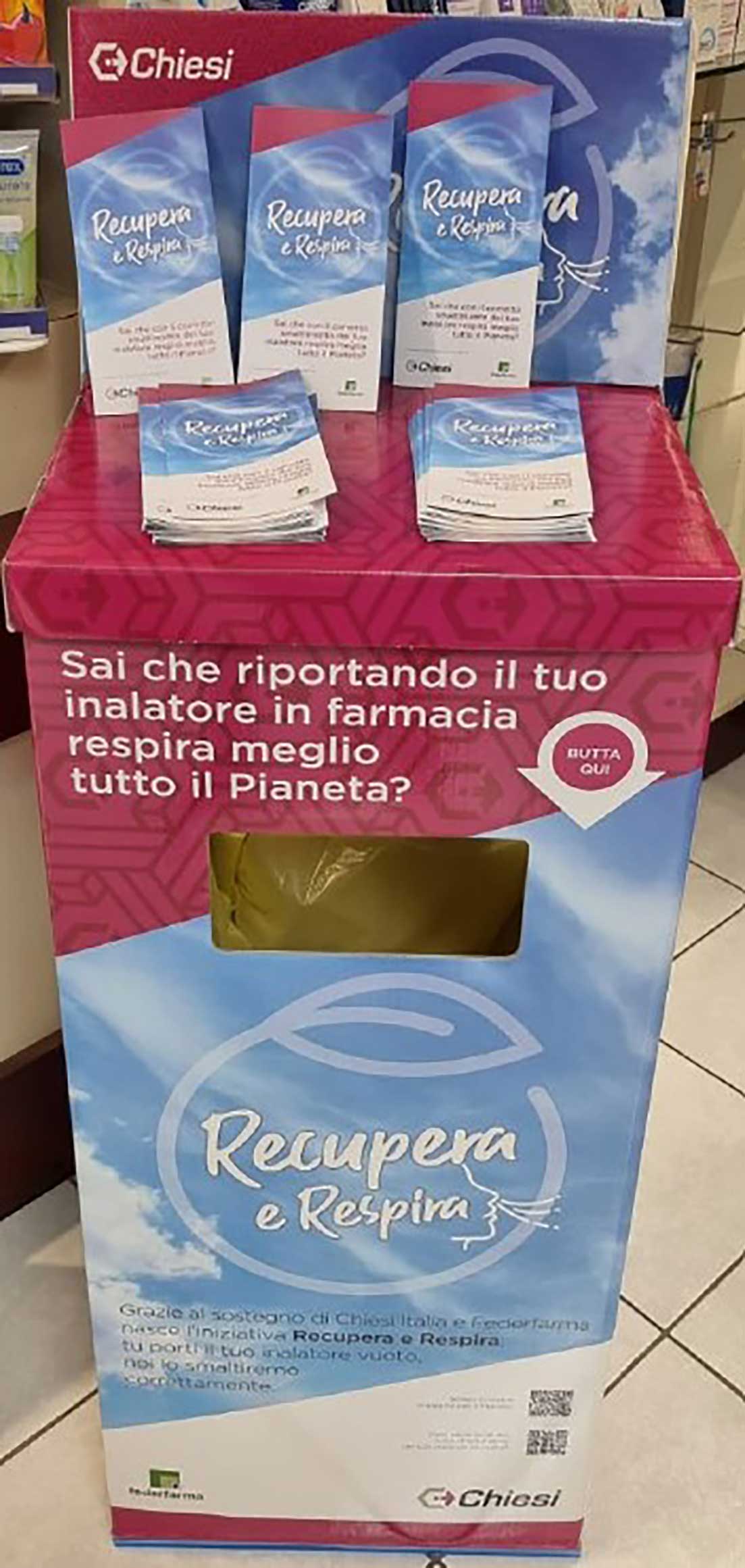
Recupera e Respira, a pilot project launched in the Friuli Venezia Giulia region in Italy in 2022, addresses the environmental impact of improper disposal of respiratory inhalers. When these medical devices are disposed of as regular household waste without segregation, they contribute to pollution with aluminum and plastic, and emission of residual hydrofluoroalkane (HFA). In collaboration with Federfarma, the national association representing over 19,000 private pharmacies affiliated with Italy’s National Health Service, and with the support of Assinde, a company specializing in pharmaceutical returns management and the safe disposal of expired or unused medicines, Chiesi Italy suggested and implemented an institutionally approved collection and disposal system for empty inhalers. This initiative achieved a recovery rate of 24.6% over 3 years (calculated from IQVIA sell-out data referring to the Friuli Venezia Giulia region for September 2022 to June 2025), collecting over 111,000 inhalers from regional pharmacies. Proper disposal occurred at certified facilities capable of neutralizing hazardous components at high temperatures. The project highlights the role of pharmacies in educating patients and facilitating sustainable healthcare practices. An increase in recovery rates from 22.6% to 27.3% was observed in the first 2 years of project, with a sightly decrease over the third year. Overall, this study demonstrates the model’s potential scalability, aligning with Chiesi’s net zero goals by 2035. The study highlights how innovative waste management systems can effectively reduce the environmental burden of inhalers and foster public engagement in sustainability.
References
1. Whitmarsh L, Poortinga W, Capstick S. Behaviour change to address climate change. Curr Opin Psychol 2021;42: 76-81. doi:10.1016/j.copsyc.2021.04.002
2. Pernigotti D, Stonham C, Panigone S, Sandri F, Ferri R, Unal Y, Roche N, et al. Reducing carbon footprint of inhalers: analysis of climate and clinical implications of different scenarios in five European countries. BMJ Open Respir Res 2021;8:e001071. doi:10.1136/bmjresp-2021-001071
3. Panigone S, Sandri F, Ferri R, Volpato A, Nudo E, Nicolini G, et al. Environmental impact of inhalers for respiratory diseases: decreasing the carbon footprint while preserving patient-tailored treatment. BMJ Open Respir Res 2020;7:e000571. doi:10.1136/bmjresp-2020-000571
4. de Boer AH. The environmental burden of inhalation. Eur J Pharm Sci 2025;204:106893. doi:10.1016/j.ejps.2024 .106893
5. Sharma R, Sharma M, Sharma R, Sharma V. The impact of incinerators on human health and environment. Rev Environ Health 2013;28:67-72. doi:10.1515/reveh- 2012-0035
6. Rabl A, Spadaro JV, Zoughaib A. Environmental impacts and costs of solid waste: a comparison of landfill and incineration. Waste Manag Res 2008;26:147-62. doi:10.1177/0734242X07080755
7. Abubakar IR, Maniruzzaman KM, Dano UL, AlShihriet FS, AlShammari MS, Ahmed SMS, et al. Environmental sustainability impacts of solid waste management practices in the global south. Int J Environ Res Public Health 2022;19:12717. doi:10.3390/ijerph191912717
8. Verma R, Vinoda KS, Papireddy M, Gowda ANS. Toxic pollutants from plastic waste: a review. Procedia Environ Sci 2016;35:701-8. doi:10.1016/j.proenv.2016.07.069
9. Keeley D, Scullion JE, Usmani OS. Minimising the environmental impact of inhaled therapies: problems with policy on low carbon inhalers. Eur Respir J 2020;55:2000048. doi:10.1183/13993003.01122-2020
10. Murphy A, Howlett D, Gowson A, Lewis H. Understanding the feasibility and environmental effectiveness of a pilot postal inhaler recovery and recycling scheme. NPJ Prim Care Respir Med 2023;33:5. doi:10.1038/s41533-023- 00327-w
11. European Commission. Proposal for a regulation of the European Parliament and of the Council on fluorinated greenhouse gases, amending Directive (EU) 2019/1937 and repealing Regulation (EU) No 517/2014. Eur Comm 2022.
12. Gray RCF, Hogerzeil HV, Prüss AM, Rushbrook P. Guidelines for safe disposal of unwanted pharmaceuticals in and after emergencies. Geneva: World Health Organization; 1999.
13. Nairat LL, Abahri NA, Hamdan YA, Abdel-Khaliq RT, Odeh SM, Abutaha S, et al. Assessment of practices and awareness regarding the disposal of unwanted pharmaceutical products among community pharmacies: a cross-sectional study in Palestine. BMC Health Serv Res 2023;23:1035. doi:10.1186/s12913-023-09888-5
14. Urrutia-Pereira M, Chong-Neto HJ, Winders TA, Solé D. Environmental impact of inhaler devices on respiratory care: a narrative review. J Bras Pneumol 2023;48:e20220270. doi:10.36416/1806-3756/e20220270
15. Raczkiewicz D, Sarecka-Hujar B, Pawełczak-Barszczowska A, Bojar I. How do Polish pharmacy staff evaluate own qualifications, competences, relevance, motivation, effectiveness in health promotion? Health Promot Int 2022;37:daab043. doi:10.1093/heapro/daab043
Downloads
Published
Issue
Section
License
Copyright (c) 2026 The Author(s)

This work is licensed under a Creative Commons Attribution-NonCommercial 4.0 International License.
Mattioli 1885 has chosen to apply the Creative Commons Attribution NonCommercial 4.0 International License (CC BY-NC 4.0) to all manuscripts to be published.
How to Cite